Discussions about job interviews almost always focus on the beginning: first impressions, rapport, good questions, active listening and helping candidates open up. These matter, but one area often receives little attention: how we end the interview.
Employers invest heavily in planning, professional delivery and gathering relevant information. As the conversation ends, however, energy can fade. The interviewer has their answers, the next meeting is approaching and the ending becomes a few hurried sentences before the candidate leaves or disconnects. That misses an opportunity for both the candidate experience and the quality of the decision.
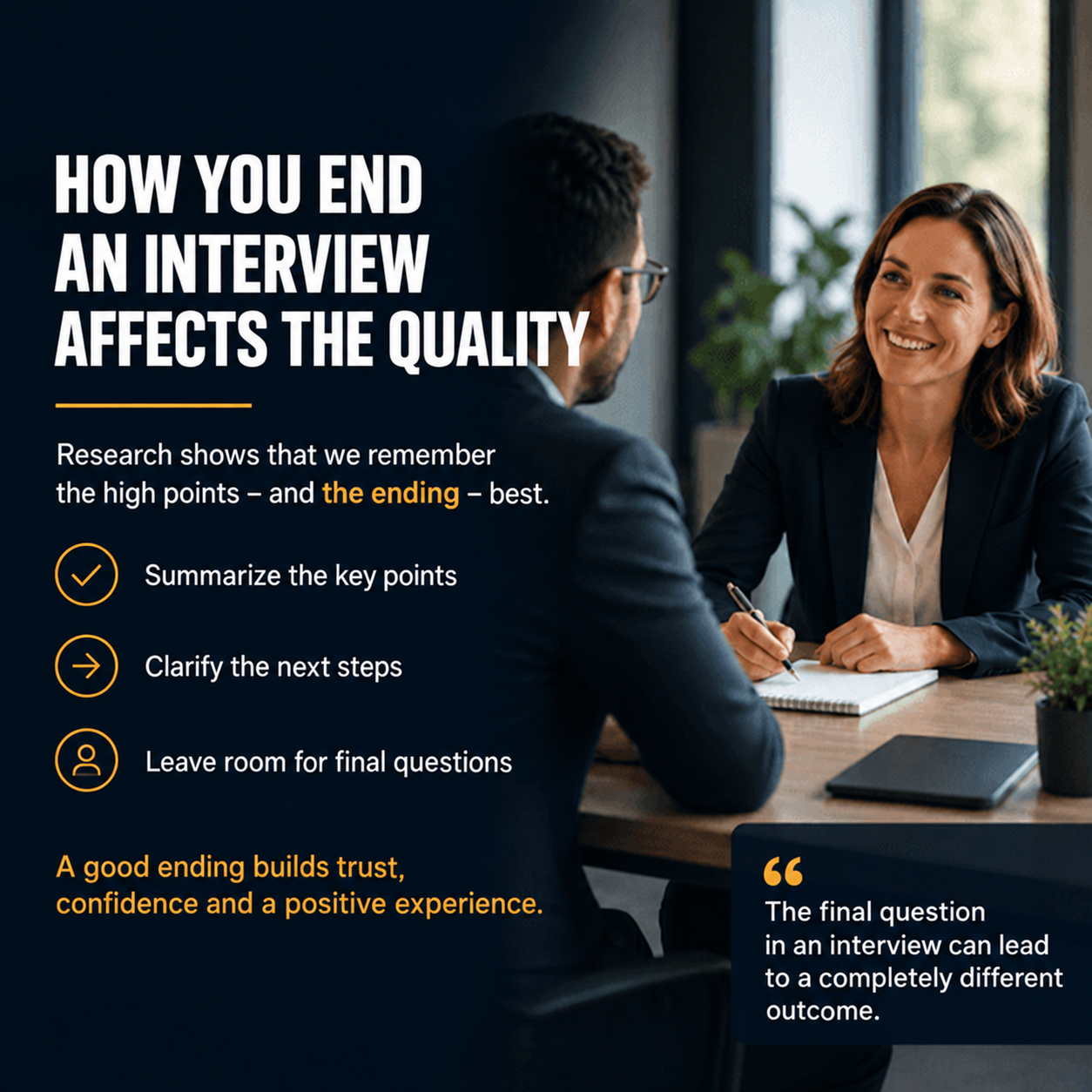
Psychology offers an interesting insight: people do not remember experiences as complete recordings. We do not retain every question, answer or minute of an interview. Emotional moments and the way an experience ends can leave a particularly strong impression.
For a candidate, the final part can therefore carry disproportionate weight. You may have conducted a useful interview with relevant questions and good dialogue, but a confused, cold or uncertain ending can dominate the memory. A professional, considered ending can instead make the whole process feel organised, respectful and trustworthy.
An interview is a place to assess a candidate, but the candidate is also assessing the organisation. Every interaction shapes their impression of the business, culture and people. Treat the ending as a deliberate part of the interview rather than a formality before the next task.
The conversation is still happening
A common mistake is to consider the interview finished once the planned questions have been asked. You mentally move to evaluation or the next candidate. Yet the person is still in the room or on screen. The relationship remains active and information can still be exchanged.
Sometimes candidates only feel sufficiently comfortable towards the end to share what matters most. They have got to know the interviewers, understood the tone and had time to reflect. Important perspectives can emerge if you make room for them.
The ending should therefore offer more than a polite thank-you. Give candidates a chance to add, correct or expand on what has been said. “Is there anything we should have discussed that we have not covered?” can sometimes be more useful than several earlier questions. The candidate has not suddenly become more capable; confidence and reflection have had time to develop.
Make the next steps clear
Another problem arises when someone leaves without knowing what happens next. What now? How many candidates remain? When will feedback arrive? Who will contact me? Does silence mean a delay?
Less information creates more room for speculation and uncertainty. People fill gaps with assumptions that may be wrong. A good ending should therefore explain the next steps clearly. You do not need to share confidential details, but provide as much predictability as possible.
This is also about trust. Knowing what to expect makes a process feel more professional and fair. The same principle applies to performance conversations, leadership development, conflict resolution and many other workplace relationships.
Respect is visible in the details
Organisations talk about employer branding while sometimes overlooking small interactions. Candidates who feel respected may speak positively about a process even when they do not get the job. Those who feel poorly treated can remember it for a long time.
Show sincere interest, communicate clearly and recognise the time and energy invested. Thanking someone, summarising the conversation and explaining the next steps signals that you value them. That signal may outlast the memory of your individual questions.
The best interviewers have a plan. They know what they want to understand, how to gather information and how to close the conversation. Interview quality depends partly on how the candidate leaves.
A good ending should be as considered as the opening. Allow final contributions, explain what comes next and ensure the person feels treated with respect. This usually takes only a few minutes, but the effect can be significant.
An interview is not finished when you ask your final question. It finishes when the candidate leaves understanding the next steps and feeling their time, experience and contribution were taken seriously. That is often what they remember when describing your organisation to others.
How do you close interviews? We welcome your reflections and questions.
English editorial adaptation of the Norwegian original.
Bring the ideas into your organisation.
Talk to us about your leadership, team or recruitment challenge.
Book a conversation ↗