
Throughout a recruitment process, we spend a great deal of time trying to understand what a candidate is likely to do if we hire them. We review CVs and applications, conduct screening, use digital tools and ask questions in interviews. We explore experience, ask candidates to describe previous situations and try to understand how they think, collaborate, solve problems and handle difficult situations. When done well, this gives us a great deal of valuable information.
But at some point, a fairly simple question becomes relevant: Why do we keep talking about how a candidate works when we can also give them the opportunity to show us?
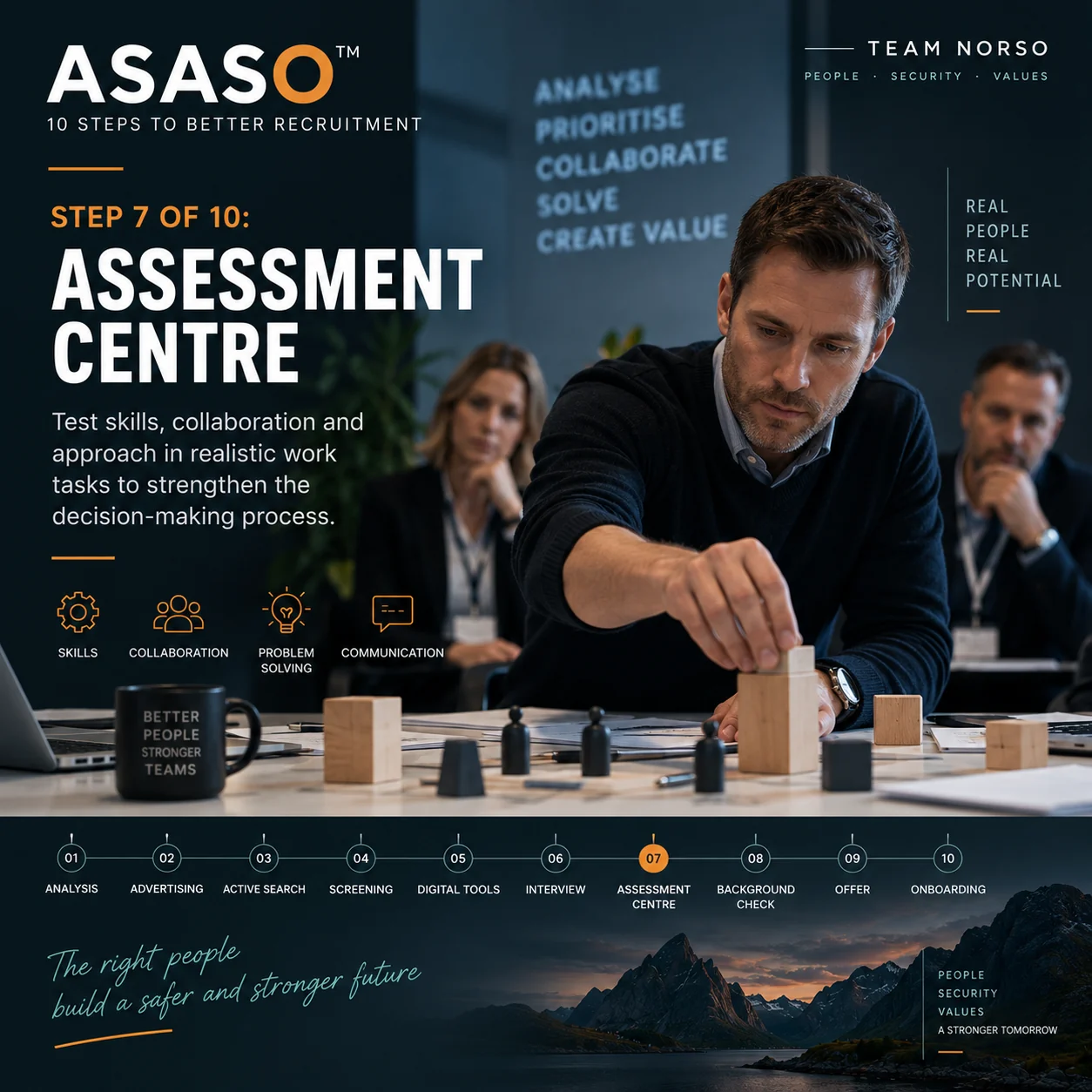
That is the starting point for Step 7 of ASASO™, the Assessment Centre. At this stage, part of the assessment moves from conversation to action. The candidate is given one or more tasks that, as far as possible, reflect situations, challenges or ways of working they are likely to encounter in the actual role.
We are not only interested in whether the candidate arrives at a good answer. We observe how they approach the problem, what information they ask for, what they prioritise, how they handle uncertainty, how they communicate, which decisions they make and how they explain those decisions afterwards.
And one point should be made clear from the outset: You need to distinguish between the competence a candidate genuinely needs from day one and what can reasonably be learned and developed after they start the job.
This is the seventh article in our series on ASASO™, TEAM NORSO's structured methodology for recruitment and selection. In the previous steps, we have analysed the need, worked with advertising and active search, screened candidates, used digital tools and conducted interviews. At this stage of the process, only a small number of candidates will normally remain. A practical assessment can then give us information that is difficult to obtain simply by having another conversation.
An Assessment Centre can be simple
Internationally, the term "assessment centre" is usually associated with a relatively comprehensive and standardised process involving several exercises, multiple trained observers and a systematic integration of the observations. This is also the traditional professional definition of an assessment centre.
Within ASASO™, we use Assessment Centre as the name for the whole of Step 7, so our use of the term is somewhat broader. In one recruitment process, this may consist of a short written work sample in which the candidate receives a realistic problem and one qualified person assesses the response afterwards. In another, it may involve several exercises over a number of hours, trained role-players, subject matter experts, representatives from the hiring organisation and several observers assessing the candidate against predefined criteria.
The principle remains the same even though the scale is different.
More is not automatically better. A large assessment centre with five exercises and six observers can provide a poorer basis for decision-making than one well-designed work sample if the exercises are not relevant to the job or the observers do not know what they are looking for. At the same time, several relevant exercises, repeated observations and multiple qualified observers can significantly strengthen the quality of the assessment when the process is properly designed and executed.
The scope therefore has to be decided from one recruitment to the next.
Keep it simple, but do enough to obtain the information you actually need.
Everything must start with the job analysis
One of the most common mistakes is to begin by asking: "What case should we give the candidates?"
That is the wrong starting point.
A better question is: "What do we still need to find out about the candidate, and how can we create a work situation in which that becomes observable?"
The answer should take us back to Step 1 and the job analysis.
If the analysis has shown that a manager needs to prioritise when several competing issues demand attention, handle resistance from experienced employees and communicate clearly upwards in the organisation, then we can create a situation in which the candidate actually has to do those things.
If, on the other hand, the position is a security role where the critical requirements are identifying risk, distinguishing important information from noise and giving practical recommendations to a manager without a security background, then the exercise should be designed around exactly that.
An exercise is not good because it is difficult. It is good when it produces behaviour that is relevant to the job.
This is also why generic business cases often have limited value. If a candidate is applying for a security position, there is little reason to ask them to develop a strategy for a fictional supermarket chain simply because somebody found a ready-made case online. At that point, we may be measuring the candidate's ability to solve our case rather than their ability to perform the job we are actually hiring them to do.
Research and professional guidance point in the same direction. Skills-based assessments should resemble real work as closely as is practically possible, and the exercises used in an assessment centre should have a clear connection to the requirements of the role.
The candidate is not free labour
There is an important counterpoint here. When we move from conversations to practical tasks, we increase the burden on the candidate. That needs to be considered before we start.
It can be tempting to think that a candidate who genuinely wants the job should be willing to spend an evening or two preparing an extensive case. We think that is the wrong approach. The candidate may already have a demanding job, a family and other commitments. They may not even have told their current employer that they are considering a move.
If an organisation asks a candidate to spend five, ten or fifteen hours of their own time completing work that primarily exists to reduce the employer's uncertainty, there should be a very good reason for doing so.
There is another problem as well. The more work a candidate is allowed to complete at home in advance, the less we know about who actually produced it. They may receive help from friends, colleagues, subject matter experts or artificial intelligence. We may end up assessing an excellent final product while learning very little about how the candidate actually works.
For that reason, we often prefer several smaller, realistic tasks carried out within controlled conditions rather than one large assignment handed out a week in advance. The candidate should understand why the assessment is being conducted, how it forms part of the process and what kinds of capabilities we are trying to examine. Participation should take place with the candidate's consent.
This is not simply a question of courtesy. It is about professionalism and reputation. An employer that burdens candidates with meaningless tasks is also communicating something about how it values other people's time.
Do not test presentation skills if the job is not about presentations
A recruitment classic is to give the candidate a case, ask them to create a PowerPoint presentation and then present their solution to a panel. That can make sense when presenting information, communicating and persuading a group are genuinely important parts of the role.
The problem is when this format is used almost automatically.
The candidate who produces the most polished presentation, appears most comfortable in front of an audience and has had the most time to prepare may come across as the strongest candidate, even though none of those things are particularly important in the actual job.
Realism should matter more than how impressive the assessment centre looks.
If a manager's real working day is primarily about handling difficult people situations, prioritising between competing demands and making decisions with incomplete information, the candidate should be asked to do something that resembles that reality.
If a security adviser is expected to analyse information, identify vulnerabilities and give a manager three practical recommendations, then that should be the task. Not a twenty-minute presentation on the candidate's "strategic approach to security".
An assessment centre should not be a show put on by the employer. It should be a method for collecting relevant information.
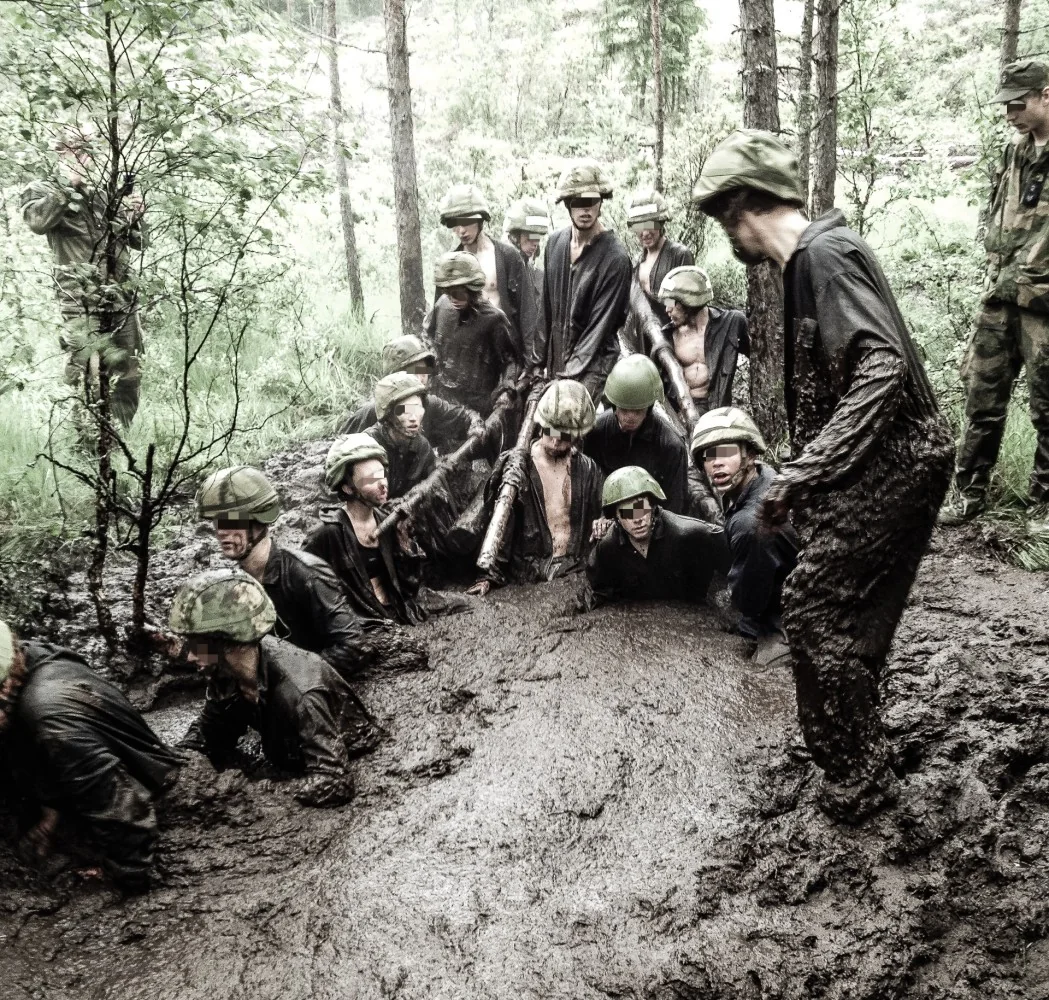
Assessment centres are used extensively in the Norwegian Armed Forces.
Example: The candidate applying for a management role
Imagine that we are recruiting a manager for a department of around 25 employees. Through the job analysis, we have established that the department delivers strong professional results, but has difficulties with collaboration, prioritisation and accountability. Two experienced employees have considerable informal influence, there have been several conflicts, and the manager's own supervisor expects improved results within six months.
In the interview, we could ask the candidate: "How do you handle conflict?" or "How do you approach change?"
Those questions can provide useful information, particularly when the interview is structured and the candidate is asked to describe specific previous situations. But the candidate may also simply be very good at talking about leadership.
In the assessment centre, we can actually observe it live.
The candidate is first given ten minutes to review a short set of information about the department. The information is deliberately incomplete. Some key figures show declining performance, the employee survey indicates low trust between parts of the team, and three short emails from employees present different explanations of the problem. The candidate is told that they have just started as the department's new manager and must prepare their initial actions.
We can already observe a great deal. What does the candidate notice first? Do they jump to conclusions, or distinguish between facts and assumptions? Do they ask for additional information? What questions do they ask? Is their immediate reaction to reorganise the department, or do they first try to understand what is actually happening?
The candidate then meets a trained role-player acting as an experienced employee. The employee is professionally strong, but believes that "the new employees" are the source of the problem and gradually tries to persuade the new manager to take their side.
The task is not to "win" the conversation.
We observe whether the candidate allows themselves to be drawn into a conflict they do not yet understand, how they listen, what questions they ask, how they challenge claims and how they balance relationship-building with clarity.
At the end, the candidate is given five minutes to explain to the observers what they would do next and why.
That final part matters. The candidate may have made a choice during the exercise that initially seemed unusual to the observers. When the candidate explains that this was a deliberate decision intended to test a hypothesis without signalling support for either side, we gain valuable information. We are not only assessing what the candidate did, but whether their actions were based on reflection and deliberate priorities.
Example: The security adviser who receives too much information
Another example could be the recruitment of a security adviser. The analysis shows that the role requires professional expertise, but that the ability to assess risk, deal with incomplete information and communicate security issues to leaders without a security background is just as important.
The candidate receives a set of information about a fictional organisation: a floor plan, several non-conformities, excerpts from procedures, an email from a concerned employee, information about an upcoming event and some details from previous incidents.
There is deliberately more information than the candidate can analyse thoroughly within the available time.
The task itself can be simple:
"You are meeting the Managing Director in 25 minutes. What does the Managing Director need to know now, what needs further investigation, and which measures would you recommend first?"
The final answer is interesting, but the process is even more interesting.
Does the candidate spend the first ten minutes on a single technical detail and lose sight of the bigger picture? Do they identify which pieces of information could genuinely change the risk picture? Do they distinguish between what we know and what we assume? Do they try to obtain more information? How do they prioritise measures when both time and money are limited? Can they explain risk clearly without either exaggerating or downplaying it?
During the exercise, the candidate may receive new information. A trained role-player could act as an operations manager who believes that the security requirements are excessive because the measures will delay production.
We suddenly have an opportunity to observe something beyond pure professional knowledge.
How does the candidate handle resistance? Can they understand the operational requirements without abandoning their professional responsibility? Can they explain consequences and risk in a way that the recipient can actually use?
This takes us much closer to the real job than asking: "How do you handle resistance to strict security measures?"
The process is often more interesting than the answer
When running an assessment centre, it is easy to become too focused on the final result. Candidate A found the solution. Candidate B did not. Therefore Candidate A must be better.
It is rarely that simple.
In many knowledge-based roles, there is no single correct answer. The candidate may not even receive all the information required to make a perfect decision. That is why we are often more interested in how the candidate moves through the problem than exactly where they end up.
We look for observable behaviour. What does the candidate do when something is unclear? What questions do they ask? What do they choose not to prioritise? How do they balance time against quality? Do they change direction when new information emerges? Can they acknowledge that something is unknown? How do they explain their decisions? What happens when somebody disagrees with them?
This requires assessment criteria to be defined in advance.
"Seems strategic" is a poor criterion.
"Distinguishes between short-term measures and long-term consequences, identifies dependencies and explains priorities" is far more useful.
"Good communication" is vague. Instead, we can define the communication behaviour the role actually requires and observe whether the candidate demonstrates it.
This makes the assessment more demanding to prepare, but considerably more useful.
Tools should normally reflect reality
The same principle applies to tools and resources.
If the employee would normally use Excel, the internet, a calculator, professional reference material or artificial intelligence in the real job, the starting point should be that the candidate is also allowed to use relevant tools in a work sample.
Sometimes, of course, it is the candidate's knowledge or ability without support tools that we specifically want to test. In that case, limiting access may be appropriate. But it should be a conscious decision.
AI makes this particularly interesting. If the candidate is likely to use AI in the job, we may actually learn more by allowing them to use it than by banning it. We can observe how the candidate frames the problem, evaluates the output, identifies errors, checks sources and takes responsibility for the final result.
In some roles, that may be far more relevant than finding out who can complete the same task without the tools they would normally use at work.
Again, we return to the same question: What does the job actually require?
Observers need training
A good exercise cannot compensate for a poor observation team.
For larger assessment centres, we therefore establish an observer team that includes TEAM NORSO together with relevant representatives from the hiring organisation. This might include the hiring manager, HR, a subject matter expert or others who have a genuine reason to contribute to the assessment.
But it is not enough to give them a sheet of paper and say: "Write down what you think."
Observers need to understand the exercise, the criteria and their own role. They need to understand the difference between what they actually observe and their interpretation of what is happening. They must be able to record relevant behaviour, link those observations to agreed criteria and use the rating scales in reasonably consistent ways.
Observer training is also a central principle in international assessment centre methodology.
A classic mistake is for an observer to write: "Weak leader."
On its own, that is almost useless information.
What actually happened?
The candidate interrupted the employee three times. The candidate took a position on the conflict before both perspectives had been explored. The candidate failed to establish any clear expectations for what should happen next.
Those are observations we can discuss and assess.
"I just didn't get a good feeling about them" is something entirely different from something you have actually observed.
Assess individually first, discuss afterwards
After an exercise, observers should make their assessments individually before the group discusses the candidate. This is a small measure with considerable importance.
If everyone sits around the table and the most experienced or senior person starts by saying, "I thought that was very strong", it becomes difficult for everyone else to remain completely unaffected. Human beings influence each other, even when we are actively trying to be objective.
Each observer should therefore first document their observations and make an independent assessment. The information is then brought together.
Disagreement is not a problem.
Disagreement is useful information because it forces us to return to what we actually observed. The same principle is used in recommendations for structured selection processes specifically to reduce the influence observers may have on one another.
The goal is not for everyone to agree. The goal is for the final assessment to be explainable using relevant information.
Group exercises can work, but they can also become rather strange
Traditional assessment centres often use group exercises in which several candidates solve a task together. This can provide useful information about collaboration, communication and influence, but there is an obvious challenge.
The candidates are simultaneously experiencing the situation as a competition.
That creates an artificial dynamic. Should the candidate be a good team player, or make sure the observers notice them? The person who speaks the most may appear more active, while the candidate who listens, structures the group's work or helps other people contribute may actually be the one creating the most value.
Candidates will also face different situations depending on the people they happen to be grouped with.
For that reason, we often use a more controlled alternative.
Trained and prepared role-players are given defined roles in the exercise. They know what information to provide, how to respond and which challenges to introduce. Candidates can therefore face approximately the same situation, giving us a stronger basis for comparison.
A group exercise involving several candidates can still be appropriate. But candidates should understand what they are taking part in, consent to the process and know what is being assessed.
As with every other part of the assessment centre, the method should be used because it gives us information we need, not because "assessment centres normally include a group exercise".
The reflection afterwards may reveal more than the exercise itself
When the exercise ends, the assessment is not necessarily finished.
A short reflection discussion can provide highly valuable information.
Why did you choose to do that first? What were you most uncertain about? What information were you missing? Was there anything you deliberately decided not to do? What would you do differently if you had another hour? Which risk did you consider the most significant?
Questions like these allow candidates to explain what was behind their actions.
This matters because two candidates can do almost exactly the same thing for completely different reasons. One has made a deliberate choice after considering several alternatives. The other happened to arrive at the same solution.
The final result looks similar, but the decision-making process is very different.
Reflection should not, however, be used to explain away everything that happened. The observation still stands. The candidate is simply given the opportunity to provide additional information about it.
An Assessment Centre is not automatically a good method
It is tempting to describe assessment centres as a kind of gold standard in recruitment.
The research tells a more complicated story.
There is evidence that overall assessments from well-conducted assessment centres can provide information about later performance, while more recent professional reviews also point to significant weaknesses in some traditional competency-based approaches. Work samples and realistic skills-based exercises remain important because candidates are actually given the opportunity to demonstrate job-related behaviour.
For us, this distinction matters.
We do not use assessment centres because the method has an impressive name or because it feels thorough. We believe in the principle of using realistic and relevant situations to obtain information we genuinely need.
A poorly designed assessment centre can create a dangerous illusion of quality. There are many people in the room, the candidate completes sophisticated exercises, forms are filled in and eventually a report is produced. It looks scientific.
But if the exercises are not based on the job analysis, the assessment criteria are unclear and the observers lack competence, the entire process may amount to little more than structured guesswork wrapped in an expensive package.
That is one of the reasons assessment centres require competence to design and run properly.
The most common mistakes are actually quite simple
Many of the same mistakes occur repeatedly.
The exercise is too generic and poorly connected to the job. The candidate is assessed on presentation skills even though presentation has little relevance to the role. Observers are given vague criteria such as "robust", "strategic" or "good leader", without anyone defining the concrete behaviour those words are supposed to represent.
Too much weight is placed on the final answer and too little on how the candidate arrived there.
One dominant observer influences the whole assessment team.
Or the assessment centre becomes so extensive that the employer uses enormous resources, and the candidate spends an entire day demonstrating something that could have been established through a well-designed 45-minute work sample.
The opposite also happens. The organisation has identified critical capabilities that could easily have been examined in practice, but skips this entire step because the interview "felt really good".
That is considerably harder to defend.
If a capability is critical to whether a candidate will succeed, and we can examine it in a reasonable and relevant way before making the appointment, why would we wait until the probationary period to find out whether the candidate can actually do it?
The probationary period should not be your selection method
Sometimes we hear the argument: "We will find out whether it works during the probationary period."
In our view, that is a poor recruitment strategy.
Of course, no selection process can guarantee that an appointment will succeed. People are complex, organisations change, and some factors can only be observed once the candidate has actually started the job. There will always be risk.
But a probationary period is not an excuse for failing to investigate what could reasonably have been investigated beforehand.
By the time the employee has started, both parties have made significant investments. The new employee may have resigned from a secure position. The team has spent time on training and onboarding. Clients may have been introduced to the new employee. Responsibilities have been transferred and expectations established.
If a fundamental weakness that could easily have been identified through a relevant work sample is only discovered at that point, the recruitment process has failed.
In Norway, the Working Environment Act also provides specific protection against dismissal during an agreed probationary period. A dismissal under the probationary provisions must be based on the employee's adaptation to the work, professional competence or reliability. A probationary period is therefore not a risk-free cancellation option that employers can use instead of conducting a thorough selection process.
Termination during probation may sometimes be necessary.
But it should be an emergency solution, not a planned part of the recruitment method.
Transparency matters, including when the candidate does not get the job
An assessment centre can be demanding for the candidate. They know that several people may be observing how they solve a task, react under pressure or deal with other people.
That makes transparency and proper treatment throughout the process particularly important.
The candidate should understand why the assessment centre is being used, approximately how long it will take, what type of situations they can expect and how the information will be used.
That does not mean revealing every challenge in advance or telling the candidate exactly which behaviours the observers are trying to elicit.
But it should not be an ambush.
Once the assessment has been completed, candidates should also receive relevant feedback. A person who has invested significant time and subjected themselves to an extensive assessment deserves more than: "We have decided to move forward with another candidate."
Professional guidance also highlights the value of qualified feedback following assessment centre processes.
This is not only about taking care of candidates. It affects the employer's reputation.
The candidate who did not get the job may be a customer, a business partner, a future candidate or the person who recommends the organisation to somebody else five years from now.
From what the candidate tells us to what the candidate actually does
Across the first six steps of ASASO™, we have gradually reduced uncertainty. We have understood the role, found the candidates, sorted information, examined relevant characteristics and spoken to them in depth.
The Assessment Centre introduces a different type of information because we can observe the candidate in action.
That does not mean the assessment centre provides the answer on its own.
A candidate can have a bad day. An artificial exercise will never be identical to reality. An observer can misunderstand what they see. This step should therefore never be used in isolation.
ASASO™ is based on gathering information from several sources and assessing it together.
The difference is that we have now moved from:
"Tell me how you would do this."
to:
"Show me how you approach it."
That can be a very important difference.
In brief
An Assessment Centre is not about making recruitment bigger, more expensive or more impressive. It is about reducing the gap between what we think a candidate can do and what we have actually seen them do.
It may consist of one simple work sample or a comprehensive process involving several exercises and observers. The scale should reflect the role, the risk involved and what we still need to find out. The exercises should come directly from the job analysis, resemble real working situations and be designed so that relevant behaviour can be observed.
The candidate's process for solving the task is often more important than the final product, and the reflection afterwards helps us understand why they acted as they did.
At the same time, candidates must be treated with respect. An assessment centre places an additional burden on them and should have a clear purpose. Candidates should understand why it is being used, consent to participating and never be treated as free labour.
We should use exactly enough resources to create a stronger basis for decision-making, not put on a show.
Because if we can examine a critical capability before hiring someone, it is difficult to defend waiting until the probationary period to discover whether the candidate actually has it.
Next step: Background Check
After the Assessment Centre, we have come a long way in understanding the candidate. We have information from the CV and screening, digital tools, interviews and practical observations. We have heard what the candidate says and seen how they work.
But one important task remains before we can trust that the picture is complete.
We need to establish whether the information is accurate.
In Step 8 of ASASO™, we therefore move on to the Background Check. This involves verifying relevant information, examining previous experience and obtaining information from sources that can confirm, add nuance to or challenge the picture we have developed throughout the process.
This, too, needs to be done in a structured and proportionate way, with respect for the candidate.
What you learn through ASASO™ Certification
This article provides an introduction to the thinking behind assessment centres as part of a comprehensive selection process.
In the ASASO™ Certification programme, we work practically with how relevant work samples and assessment exercises are developed from the job analysis, how observers are prepared and how the information is integrated with the rest of the decision-making process.
You learn, among other things, how to build realistic exercises from specific requirements identified in the job analysis, choose the appropriate scale based on the role and the associated risk, define observable behaviour and clear assessment criteria, prepare observers and role-players, conduct individual assessments before the observer team integrates its findings, use reflection after exercises to understand the candidate's decisions, and run assessment centres in a way that both strengthens the basis for the hiring decision and treats candidates properly.
English editorial adaptation of the Norwegian original.
Bring the ideas into your organisation.
Talk to us about your leadership, team or recruitment challenge.
Book a conversation ↗