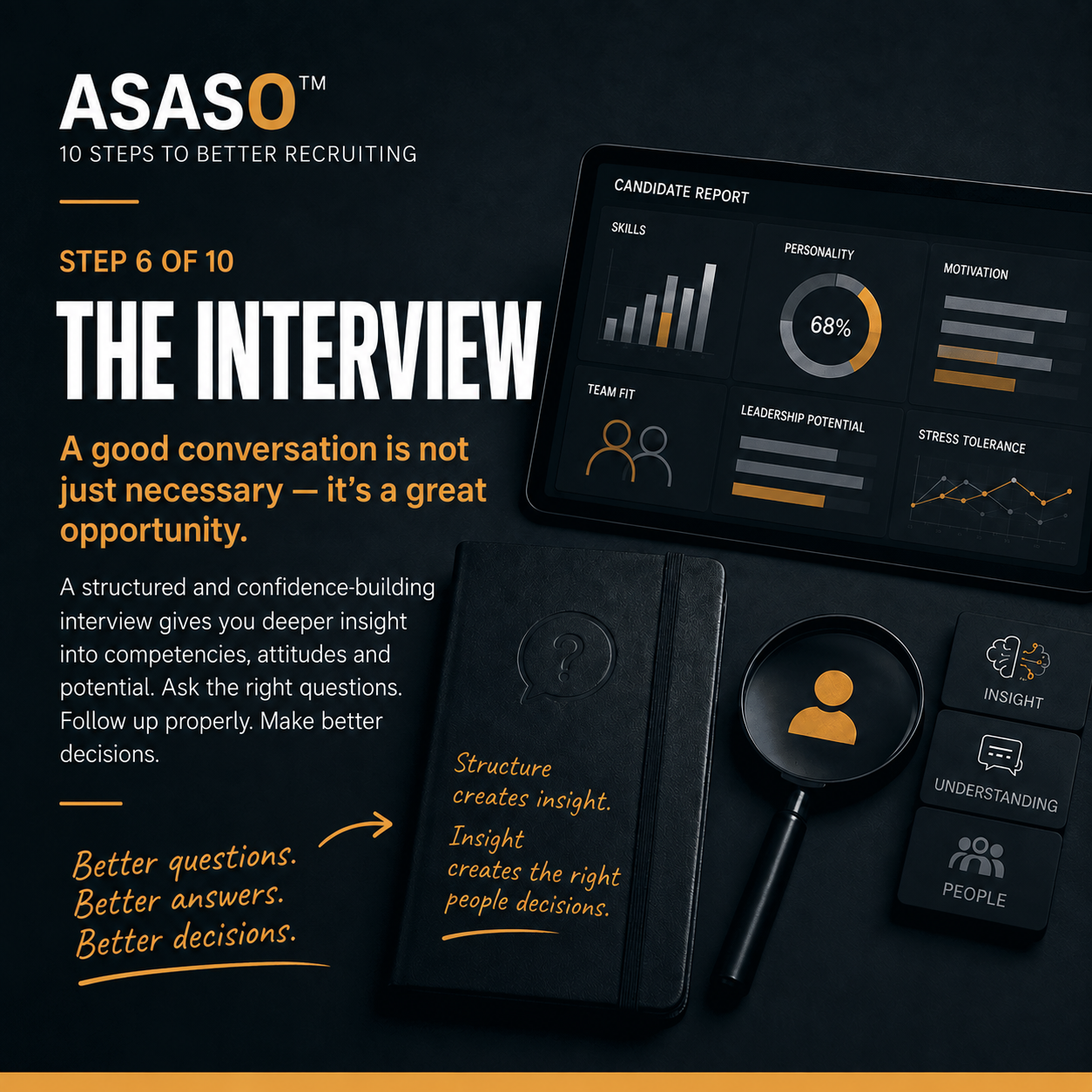
Most leaders have experience of interviews. That familiarity creates a risk: we may confuse having conducted many interviews with knowing how to conduct them well. Repeating a process can reinforce mistakes as easily as develop skill.
Step six in ASASO™ builds on analysis, advertising, active search, screening and digital tools. It is not a fresh start based on whatever interests the interviewer. The role requirements and earlier information define what needs investigation.
The interview should improve the employer’s understanding of the candidate and the candidate’s understanding of the work.
An informal setting can still have a method
Coffee and a relaxed tone can help. But if nobody has decided what to investigate, who will ask, which criteria apply or how evidence will be used, informality has replaced preparation.
Other professions invest heavily in interviewing skills because memory, question wording, expectations and interpersonal influence affect information quality. A job interview is not a police interview, but the comparison illustrates why “having a chat” is not enough.
Structure helps candidates be assessed against relevant, comparable criteria. It need not make the conversation mechanical. Skilled interviewers can follow useful leads because they understand the purpose. Less experienced interviewers benefit particularly from clear questions and criteria.
Start with the job analysis
Why did you ask that question? Habit or an internet list is not a sufficient answer.
If collaboration, independent judgement or learning complex systems matters, the interview should examine it. Clarify what each capability means in this role, what evidence would be useful and how important it is.
Familiar questions about strengths, weaknesses or future ambitions may produce rehearsed generalities. They can still be used if the interviewer knows their purpose and follows beyond the first response.
Help the candidate demonstrate capability
Explain the process, the types of questions and the time available. Allow thinking time and rephrase misunderstandings. Help people move beyond a superficial answer when relevant experience may be available.
The interview should not test whether someone can guess hidden rules. Unnecessary stress caused by aggression, poor preparation or unpredictability interferes with information gathering.
If performance under pressure genuinely matters, any related assessment should be separately justified, planned and appropriate to the role.
Trust is different from personal chemistry
Shared interests, humour or background can feel positive without demonstrating suitability. Similarity can make us interpret uncertain information generously while judging a less familiar person more harshly.
We want enough trust for honest reflection, not a decision based on whom we instinctively like. Structure helps protect assessment from those biases.
Listen, then follow the evidence
The candidate should generally speak more than the interviewer. Begin broadly, let them describe experience, then narrow towards concrete events, actions and outcomes.
STAR — Situation, Task, Action and Result — can help move from general claims to specific examples. Its value is not the acronym but the quality of information uncovered.
“I handle conflict well” is a claim. “Tell me about a particular conflict you handled” invites evidence. Follow up on what happened, alternatives considered, actions, consequences and learning.
Ask how another participant might describe the situation. This remains the candidate’s account, but invites an outside perspective and can reveal self-awareness.
Hunt for information, not faults
In AnchorView™, Hunt means following useful information with detailed questions. It does not mean trying to catch the candidate out.
People give general answers for many reasons: nerves, habit, positive self-presentation or limited previous reflection. Explain that you are asking for detail to understand their actual contribution, not because you assume something is wrong.
This makes the candidate a partner in clarifying evidence.
Separate claims, examples and interpretation
“I work well when it is hectic” is a self-assessment. A description of a demanding situation, priorities, an error and subsequent adjustment provides more concrete information. Your interpretation comes afterwards.
“Described three situations where feedback changed their approach” is different from “seems willing to learn”. The latter may be a reasonable judgement, but you should be able to explain its basis.
Understand motivation in both directions
Explore what a person is moving towards and away from. They may want to leave a current role without wanting the daily reality of this one. Status or salary may appeal while the work does not. A passive candidate may discover an opportunity that fits unexpectedly well.
Ask what provides or drains energy, what they want more or less of, and what they expect from leadership, colleagues, autonomy, flexibility, development and responsibility. What would make the role worthwhile two years from now?
The goal is a realistic match between the workplace and the person’s needs and contribution.
Explore learning and self-awareness
Success stories are not the only useful evidence. Can someone explain an approach that failed, their own influence and what changed afterwards? Can they distinguish other people’s actions from what they controlled?
The conversation cannot assess an entire person. Later methods should compare statements with observed behaviour in relevant situations.
Digital results can contribute hypotheses: “How do you recognise this pattern, and can you give an example?” is more useful than telling someone a report proves who they are.
Keep methods and roles clear
ASASO™ distinguishes the spoken interview from practical exercises in step seven, the assessment centre. Presentations, simulations and work samples provide a different kind of evidence. Knowing which method produced which information improves interpretation.
Technical knowledge can be explored verbally, but the interviewer needs enough subject expertise to distinguish fluent language from sound understanding. Bring in a specialist where necessary and agree their role, criteria, questions and timing beforehand.
Several interviewers can add perspectives, but also create pressure and confusion. Consider a simpler early conversation, adding people when their contribution is needed. Explain who is present and why.
Compare against the same criteria
Follow-up questions will vary because candidates have different experiences. Core requirements should still be explored for everyone. Afterwards, you should be able to explain what you know about each candidate on each important criterion.
If a critical capability was investigated with only half the candidates, the structure was insufficient.
Assess independently before discussing
Panel members should record initial judgements before a strong voice influences the group. A simple scale can help make differences visible.
If one assessor scores a capability at two and another at five, the important issue is why. Averaging the numbers does not resolve the disagreement.
Weighting should reflect the job analysis, not the visual symmetry of a form. Some requirements matter more, some can be developed and others are necessary at the start. Numbers support judgement rather than replace it.
When information conflicts, ask the candidate to clarify before drawing a private conclusion. You may have misunderstood.
Do not let the impression decide
A charismatic person may offer little specific evidence. A reserved person may provide detailed reflection. Neither description automatically identifies the best candidate. The evidence must still be assessed against the actual work.
Make the conversation two-way
Candidates need real opportunities to ask questions, not only a hurried final minute. Explain challenges honestly, including change, demanding periods or problems the role must address.
An informed decision not to proceed can be better than accepting an opportunity that does not match reality. Present the job that actually exists.
Use digital meetings and AI deliberately
Video meetings can efficiently clarify interest, expectations, location and practical conditions. ASASO™ generally favours at least one in-person meeting before hiring where feasible and appropriate, while recognising that impressions and body language are not truth detectors.
AI may assist preparation, transcription and organising information. People remain responsible for evaluation.
Recording and transcription require a lawful, transparent and secure process, including purpose, necessity, retention and appropriate information for the candidate. Establish the arrangements before recording, rather than assuming technological convenience is sufficient.
AnchorView™ within ASASO™
TEAM NORSO developed AnchorView™ for structured interviewing. It can be used within ASASO™ or independently.
- Align: connect questions, roles and assessment criteria with the job analysis.
- Normalize: explain the setting and create conditions for the candidate to contribute.
- Capture: gather relevant experience and concrete information.
- Hunt: follow useful leads and explore beyond general answers.
- Observe: distinguish what is heard or observed from interpretation.
- Resolve: organise evidence, compare with criteria and address differences between assessors.
The aim is an interview whose reasoning can be examined, while remaining human, curious and flexible. TEAM NORSO Academy offers training and certification in the method.
From words to practical evidence
A good interview can feel like a good conversation. Beneath it should be a plan, a method and a clear use for the information.
The next ASASO™ step is the assessment centre, where relevant tasks allow observation of skills, collaboration, communication and reflection. It helps explore whether what candidates say about themselves is consistent with what they demonstrate in practice.
English editorial adaptation of the Norwegian original.
Bring the ideas into your organisation.
Talk to us about your leadership, team or recruitment challenge.
Book a conversation ↗