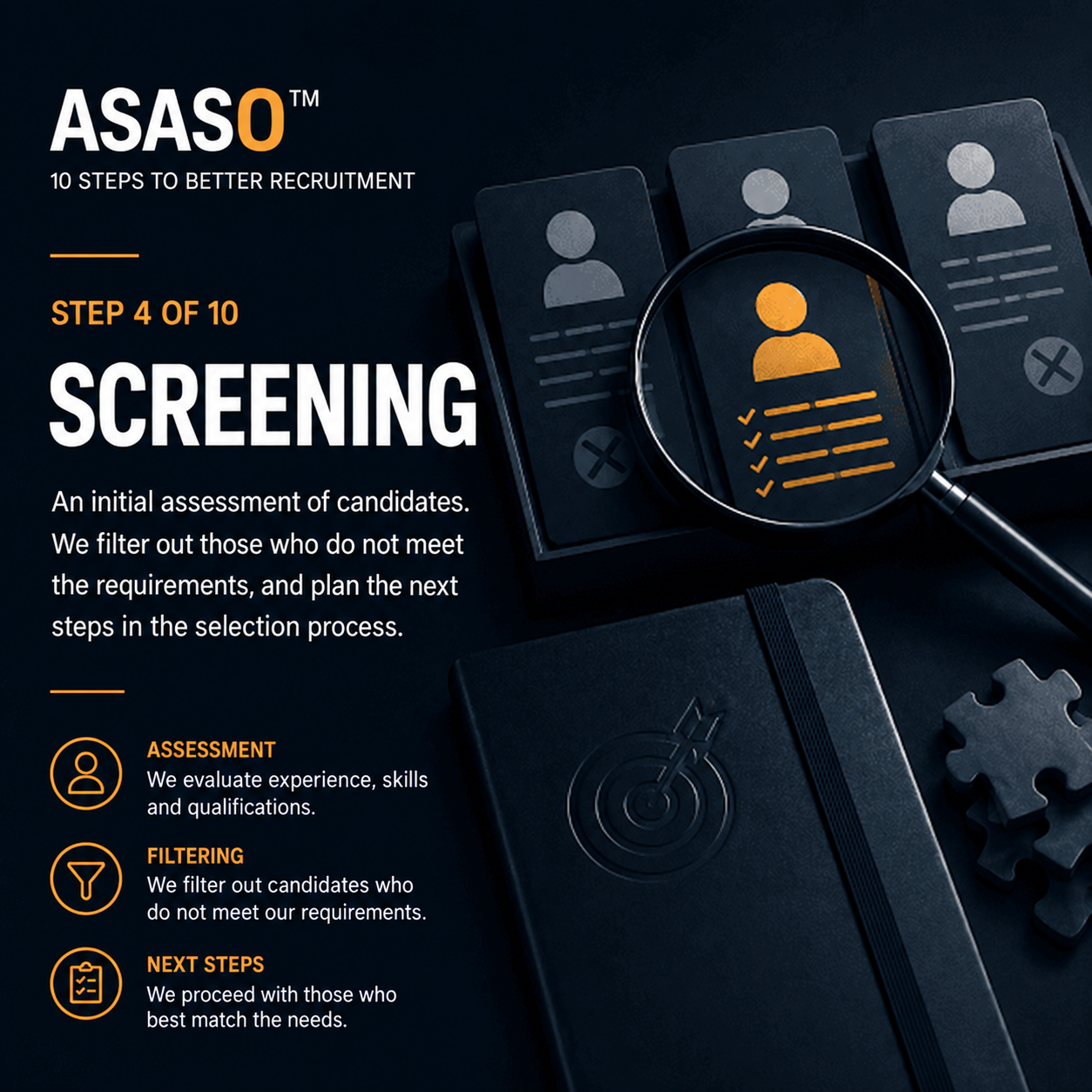
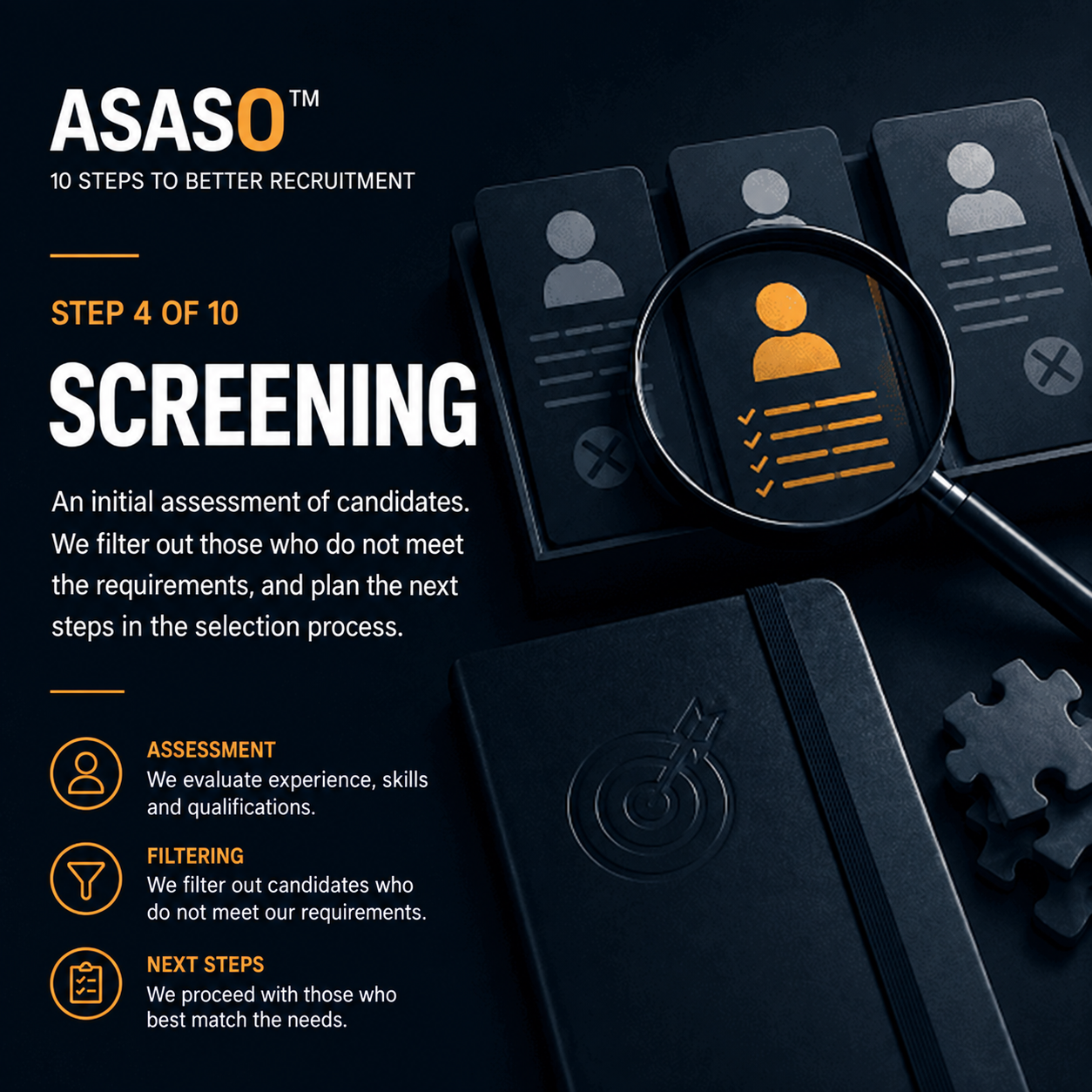
Analysis, advertising and active search have identified candidates. Screening now determines where to focus further assessment.
This is a point where recruitment can go wrong. An impressive CV may be treated as proof of strength, a career gap as a warning, a short letter as low motivation and a long one as engagement. None of those conclusions necessarily follows.
A CV describes opportunities to develop capability through education and work. It says less about what a person learned or how they applied it. An application describes how someone presents themselves, not necessarily how they will perform.
Prioritise further investigation
Screening is not choosing who gets the job. It reduces early uncertainty and identifies people whose suitability deserves closer examination.
Start with necessary requirements established in the analysis. Where a role genuinely requires an authorisation or qualification at the start, enthusiasm cannot replace it. Other skills may be developed after joining. Verify requirements according to the applicable role and jurisdiction rather than relying on a general assumption.
Next, consider relevant experience and capabilities as hypotheses to explore. Similar-industry work, large projects or familiarity with a system may be useful leads, but none determines the outcome alone.
Experience is an opportunity to learn
Predicting future performance from past information is difficult. Two people may have identical titles and years of experience while developing very differently.
One may seek feedback, take responsibility and learn continuously. Another may repeat familiar tasks without much development. The CV does not necessarily show the difference.
ASASO™ considers ability, knowledge, skills and work-related attitudes. Experience provides opportunities to develop these; it does not prove that development occurred.
Resist shortcuts
Well-known employers, familiar career paths and polished writing can influence impressions. Once someone is labelled strong or weak, confirmation bias can draw attention to supporting information and away from contradictory evidence.
Structured criteria from the analysis help counter this. Career gaps or frequent moves should prompt relevant questions, not automatic judgements. A gap may include education, caring responsibilities or other experience. A prestigious title may conceal limited responsibility.
Use an early conversation well
A short call or video meeting can clarify location, working patterns, travel, salary expectations and availability. Resolving major incompatibilities early saves time for both sides.
It is also a first real dialogue. Candidates ask questions and the recruiter can explore whether the person can explain the experience in their documents.
With AI-assisted applications, the point is not to detect tool use. It is to understand whether the documents accurately represent the person’s capability. Good writing should not substitute for evidence, and receiving writing help should not automatically count against someone.
Develop hypotheses, not verdicts
An initial impression may indicate something to investigate, but should not become the conclusion. Ask why someone moved roles, how they developed quickly or what responsibilities they actually carried.
These questions feed into AnchorView™ interviews and the other ASASO™ assessment methods. Each stage has a role; no single method should decide everything.
Information from different relevant sources can reduce uncertainty, although no process eliminates all hiring risk.
Build trust both ways
Screening is also the candidate’s encounter with the organisation. Prepared, respectful communication can strengthen interest. A hurried or disengaged recruiter may weaken it, particularly for someone with a good existing role.
The candidate is assessing the employer throughout.
Pressure to fill a vacancy quickly makes premature decisions tempting. A structured process protects time for evidence rather than allowing the first strong impression to dominate every later stage.
Document a shared starting point
Good screening records essential requirements, available evidence and questions for further assessment. It identifies who should proceed and why, giving the recruitment team a common basis for the next stages.
ASASO™ certification develops practical screening skills: applying the analysis, separating necessary requirements from other criteria, creating hypotheses, conducting an initial call, recognising bias and documenting decisions consistently.
English editorial adaptation of the Norwegian original.
Bring the ideas into your organisation.
Talk to us about your leadership, team or recruitment challenge.
Book a conversation ↗