ASASO™ connects several stages and perspectives in recruitment. Following analysis, advertising, active search and screening, step five considers digital tools.
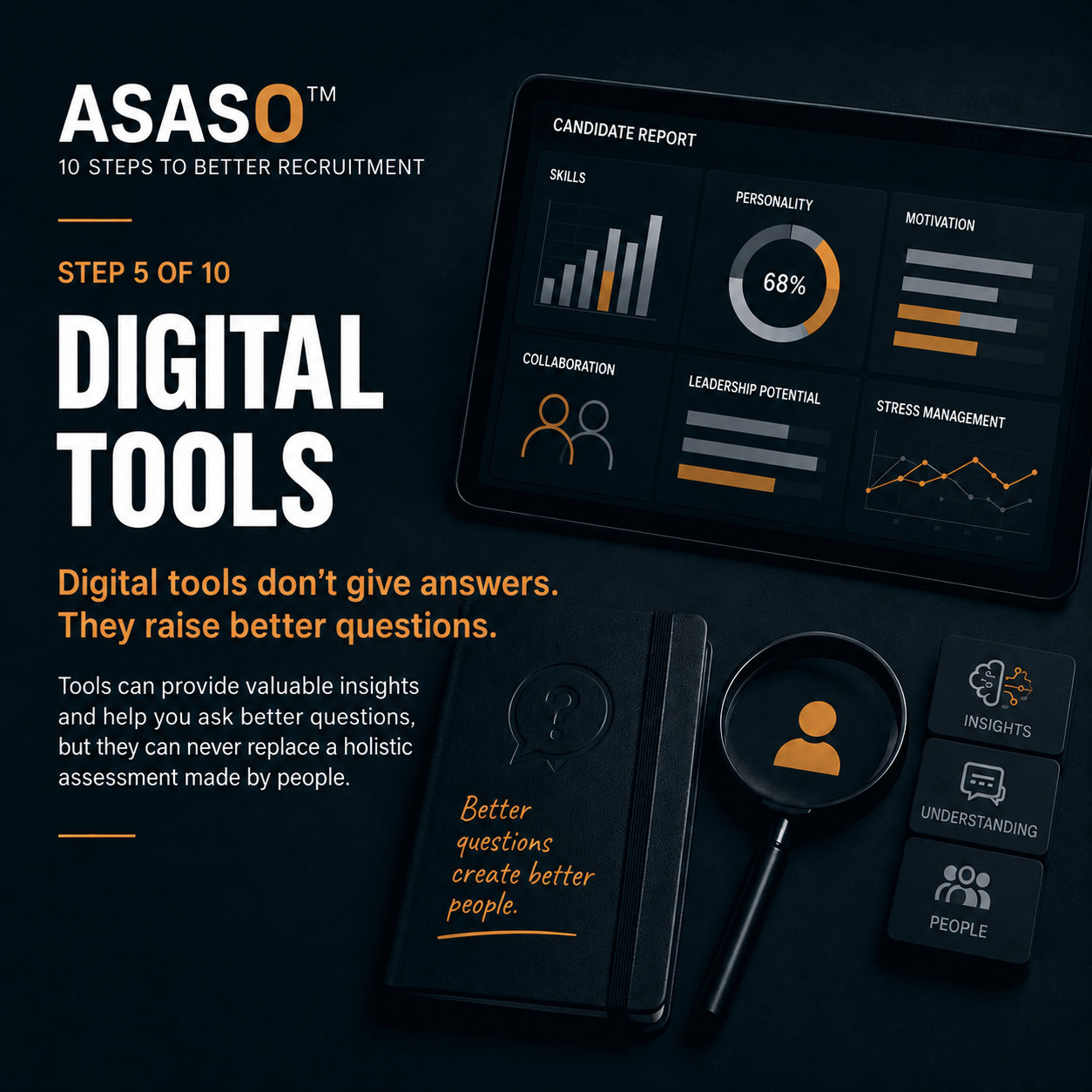
Personality questionnaires, ability assessments and motivation tools can provide useful information. Detailed reports, charts and scores can also create an impression of precision beyond what the underlying evidence supports.
A report does not know the whole person
A self-report questionnaire describes answers given at a particular time and under particular conditions. Misunderstanding, desired self-presentation or outside assistance may affect those answers.
We use the term digital tools to emphasise their supporting role. Different tools measure different things: an ability test is not the same as a preference questionnaire. Their quality and suitability must be assessed accordingly.
Professional presentation does not make a report complete or infallible.
More analysis does not repair weak input
AI can combine and summarise reports in increasingly persuasive language. Ask whether the underlying information has improved or whether the presentation has merely become more elaborate.
Uncertain assumptions do not become facts because another system analyses them.
Find questions worth exploring
TEAM NORSO uses digital tools to develop questions rather than obtain a final answer.
If a report suggests a preference for structure, explore situations requiring improvisation. What happened? How did the candidate respond? What did they learn?
Competition, social confidence or a desire for control can likewise be explored through examples, observation and relevant tasks. Reports should improve dialogue rather than replace it.
Combine methods deliberately
Structured interviews, work samples and other relevant assessments provide different perspectives. Ability tests can examine particular cognitive skills, but a high score does not establish collaboration, judgement or relationship skills.
Choose tools for a clear purpose linked to the role. More tools are not automatically better.
Respect the candidate’s time
Candidates may spend hours completing assessments, sometimes before speaking to anyone. Without explanation and feedback, it can feel as though reports matter more than the person.
Explain why a tool is being used and how its results contribute. In ASASO™, a digital report does not alone decide who proceeds or is rejected.
Two people with similar scores may behave differently in real working relationships. Context, follow-up and human interaction remain important.
Digital tools can generate hypotheses and useful reflection. They support professional judgement; they do not replace it.
The next step is the interview, where questions from earlier stages can be explored through structured conversation.
English editorial adaptation of the Norwegian original.
Bring the ideas into your organisation.
Talk to us about your leadership, team or recruitment challenge.
Book a conversation ↗